Fix Claude's Context Rot With Lemonade
A free Claude skill that ends the long-chat trap.
- Problem
- Claude chats degrade well before the window fills. By message 40, the constraint you set in message 3 is half-forgotten.
- Solution
- Lemonade — a free, MIT-licensed Claude skill that writes a structured snapshot to a Notion database you own.
- Value
- Unlimited fresh sessions without re-briefing. Your decisions, drafts, and open questions one command away.
- How it works
- distill at the end of a chat. rehydrate at the start of the next.
- Why it works
- Externalized state survives context rot. Short chats with clean context beat long chats with rich history.
Confirm your email and I'll send the free Lemonade skill.
You’ve been working with Claude for an hour. The chat is now too big to scroll to the top. Decisions got made, strategy got tweaked, drafts came out in markdown, HTML, and PPTX. Productive.
You opened it inside a Claude project, like you’re supposed to. Next chat, Claude doesn’t remember. Projects organize files; they don’t distill what happened in your last twelve sessions into anything Claude can read.
So the chat keeps growing and Claude starts to slip. You open a fresh one and paste the context back in. Miss a decision, you waste ten minutes scrolling to find it. Or you don’t, and the new chat heads somewhere wrong. Claude has memory, but it’s not the same thing as a running list of decisions, versioned drafts, open to-dos, and strategy.
- STATE
- DECISIONS
- ROADMAP
- ARTIFACT
#Problem
Three problems are stacked here.
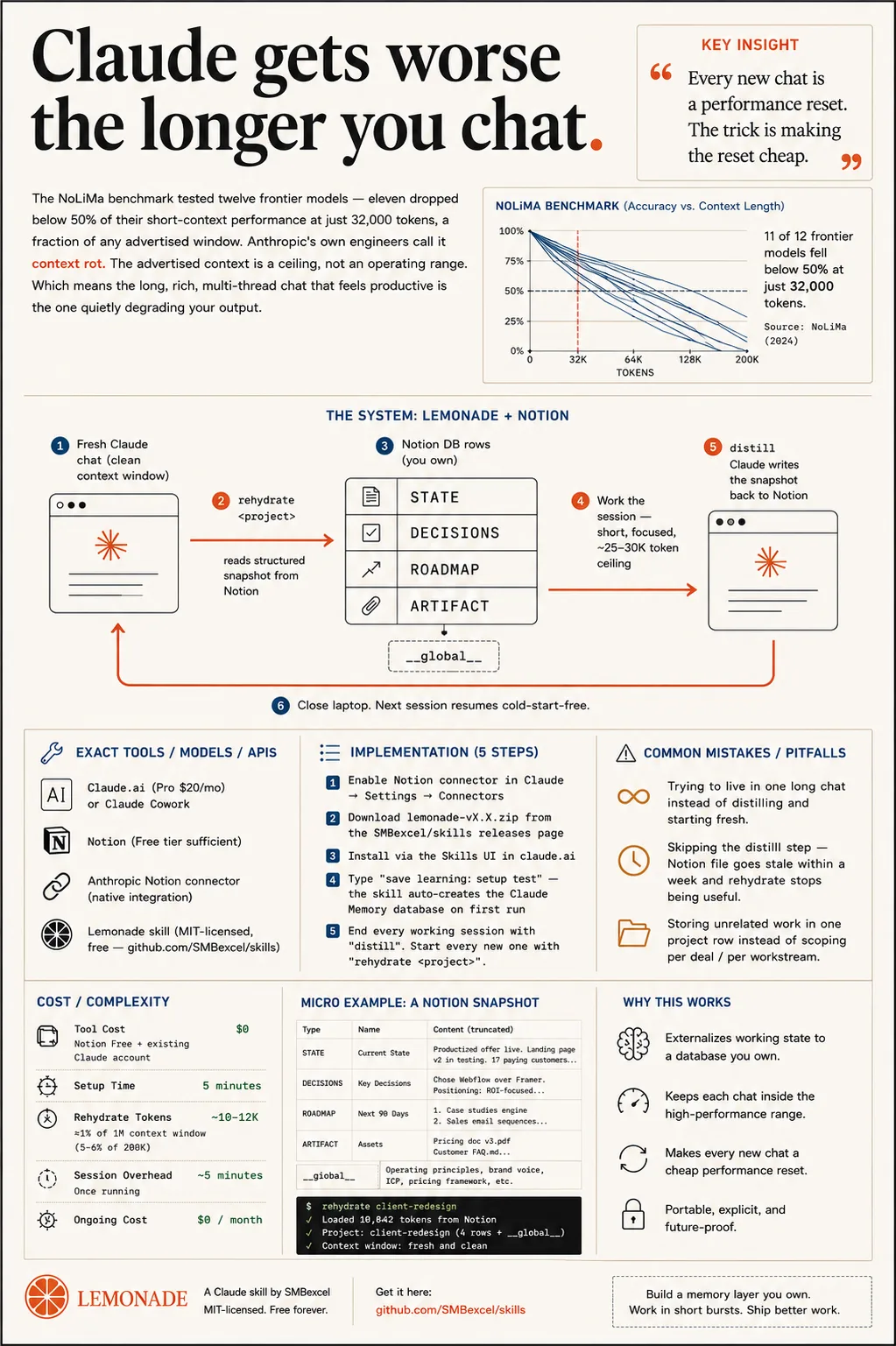
The first is context rot. Almost all frontier models drop sharply in performance well before they hit their advertised context window. Experienced operators, especially Claude Code power users, won’t let a session cross half the available window. The advertised context is a ceiling. The operating range is much smaller.
The second is that chats grow faster than humans can manage them. A typical working session generates side-quests, half-drafts, decisions, and to-dos. By the end, you’re lost and can’t find the next step. Projects organize which folder a chat lives in. They don’t solve what’s the latest, given all our chats.
The third is that Claude’s built-in memory is siloed. It handles casual context, but there’s no structured place to log a decision.
The trap: you stay in long sessions because handoff is expensive. Output degrades past the halfway mark. You accumulate a pile of chats nobody can reconstruct three weeks later, including Claude.
Every re-briefing prompt you type is a self-inflicted interruption. Anthropic’s own engineering guidance on context is blunt: a long, polluted session is a worse model than a short, clean one with the same source material.
75% of knowledge workers use AI at work, with no shared standard for preserving context between sessions. Microsoft & LinkedIn, 2024 Work Trend Index.
#Solution
Lemonade is a free, MIT-licensed Claude skill that externalizes project memory to a free Notion database you own.
What it isn’t: a replacement for Claude’s built-in memory or project folders.
What it is: a lightweight, self organizing working record. It’ll help you work more in Claude and worry less about tracking. It logs decisions, open questions, roadmap, versioned artifacts. Structured rows go into your Notion (a database you can easily read and edit). No more cold start chats
#Value
Patti · 4 active deals
Says rehydrate Cleveland. Gets LOI status, the open question about the seller's son, the three deal-structure decisions made so far, the latest QoE scope draft. Distills at the end.
Marcus · 3 board seats
Rehydrates each company before big meetings. Easily context switch across chats without missing a beat. The __global__ bucket fills with patterns over time.
Lena · running it all
ERP migration, lease renewal, lawsuit, new sales hire's 90-day plan. Each is a project but sometimes they overlap. Now the threads self organize, no more gap.
- Built-in Claude memory
- A synthesized profile of you.
- Claude Projects
- Folders for organizing chats. No aggregate state comes out.
- Pasted context docs
- Stale instantly. Don't paste.
- Lemonade
- A self organizing, human readable, 100% free database you own. Two commands run it.
Built-in memory isn’t good enough for operators. Lemonade gives you a structured record. Work and organize less while keeping track of more. Fully transparent and editable memory for all your projects. If you ever leave Claude, the memory comes with you.
Drop your email and I'll send the free Lemonade skill.
MIT-licensed. One-click unsubscribe. No spam.
#How it works
Two commands run the whole thing. End of chat, type distill. Start of next, type rehydrate. First writes a snapshot to your Notion. Second reads it back into a fresh chat.
The structure borrows from a developer-tools pattern called GSD (Get Shit Done). Four file types per project, all living as rows in a single Notion database called Claude Memory.
STATE is the snapshot: current focus, last session summary, next moves, open questions. It overwrites itself each time.
DECISIONS is the running log of every meaningful choice and the reasoning behind it (your KDDs), append-only and reverse-chronological. When a row exceeds 40,000 characters, the older half rotates into a dated archive automatically.
ROADMAP holds the long arc, what the project is, where its going, and what done looks like.
ARTIFACT versions your outputs. Latest plus previous, with one-step rollback through Notion’s native page history.
A reserved __global__ bucket holds cross-project learnings. The kind of thing you’d otherwise jot in a notebook and lose. These surface on every future rehydrate, in every project.
The skill writes without asking. The YOLO write pattern is deliberate. Done is better than perfect.
Token economics, briefly. Roughly 10–12K tokens for the first rehydrate in a fresh chat, dropping to 2–3K for subsequent rehydrates in the same chat. Pasting prior chat history burns 15–40K of unstructured context. Continuing the long-running chat is 30–100K+, and you’re operating in the rot zone the entire time.
On Opus 4.7’s 1M context window, 11K is roughly 1% of capacity. On a 200K model, 5 to 6%. The math favors externalizing.
How to set it up
- 01 Confirm Notion is connected to Claude. Settings → Connectors → enable Notion → grant access to the workspace you want it to live in.
- 02 Grab the skill. Download lemonade-vX.X.zip from github repository, unzip, install via the Skills UI in claude.ai.
- 03 Smoke-test it. Type /lemonade: setup test in a new chat. On first run the skill auto-creates the Claude Memory database in your workspace.
- 04 Run the loop. End sessions with distill. Start sessions with rehydrate <project>.
A few mid-chat commands worth knowing.
log decision appends to the current project’s DECISIONS without a full distill.
save learning writes to __global__ from any chat.
save artifact versions a specific output.
list projects returns active projects with last-distilled dates.
archive project retires a finished project, and it’s the only command that asks for confirmation, because it’s the only one that’s hard to undo.
#Why it works
Built-in memory and Lemonade solve different problems.
Built-in is for cross-chat continuity of preferences and themes.
Lemonade is for working state — the kind you audit, edit, and carry across surfaces and across models.
Short, focused chats with clean context outperform long chats with rich history.
That’s the unlock.
Confirm your email and I'll send the free Lemonade skill.
— or —